
One Team, One Experience: Turning Spring Traffic into Sales
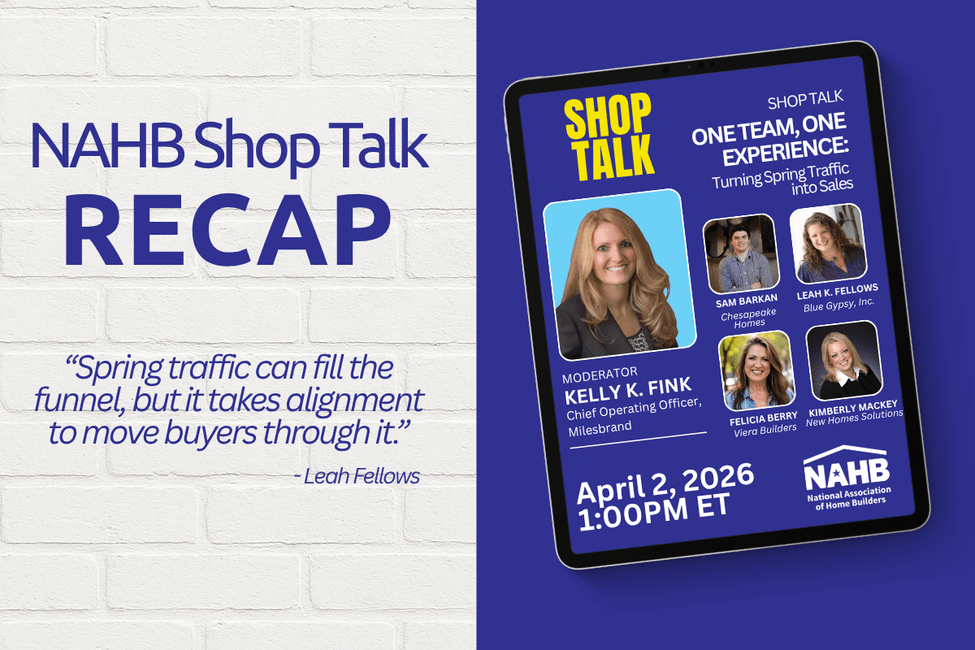 Earlier this month, I had the pleasure of joining an NAHB Shop Talk with a title so good I figured it deserved a blog post of its own: One Team, One Experience: Turning Spring Traffic into Sales.
When a topic is this relevant, this timely, and this painfully familiar to anyone in home building, you don’t just leave it neatly tucked inside a one-hour conversation. You bring it back out, dust it off, and say, “Alright, let’s talk about what this really means.”
The discussion was moderated by Kelly Fink, Chief Operating Officer at Milesbrand, and I got to share the virtual stage with a fantastic group: Sam Barkan, Gold-winning Rookie of the Year for Sales from Chesapeake Homes, Felicia Berry, Gold-winning OSC of the Year from Viera Builders, and my friend Kimberly Mackey from New Homes Solutions.
It was a smart, practical conversation, and frankly something we still haven’t gotten a handle on in 2026.
Spring selling season is historically our busiest time in the industry, but the experience is broken, then congratulations! You’ve generated more opportunities to lose buyers.
And that, friends, is not the goal.
The Biggest Disconnect? Still The Same Old Song
When Kelly asked where the biggest disconnect is today between marketing, online sales, and onsite teams, my answer was simple: Communication. And the use of the CRM. I know. It sounds almost too obvious. Like saying the biggest issue in dieting is vegetables. But here we are.
We have marketing creating polished campaigns, OSCs trying to respond quickly and intelligently, and onsite teams working hard to convert. Yet somehow, in too many organizations, the information still doesn’t travel well. Notes are incomplete. Follow-up gets fuzzy. The CRM becomes more of a suggestion than a system. And then everyone wonders why the handoff feels clunky.
A CRM is not is not the digital junk drawer where good intentions go to die. It should be the shared source of truth. When teams don’t use it consistently, the customer feels it immediately.
Why Alignment is Still So Hard
Another question that came up was why alignment feels so difficult in home building organizations right now. My honest take? Too many people are still operating from their own silo instead of the company’s larger goals.
Marketing is trying to drive traffic. Sales is trying to make numbers. Online sales is trying to qualify, nurture, and protect the experience. Leadership is trying to preserve margin. Everyone is busy. Everyone is pressured. Everyone is measured.
But not everyone understands how deeply connected their work really is.
Add to that the reality that many people do not fully understand the true costs associated with building a home, and you’ve got a recipe for internal tension. Buyers come in asking for discounts, sales teams see competitors slashing prices, marketing is trying to keep messaging competitive, and suddenly the whole machine starts reacting instead of operating strategically.
And underneath all of that? Fear. Fear of being downsized. Fear of missing numbers. Fear-based pressure masquerading as leadership.
That kind of environment does not create alignment. It creates self-protection.
What Alignment Actually Looks Like
True alignment is not a motivational poster and a quarterly meeting. It looks like marketing, OSCs, and onsite sales working from the same playbook, sharing information, and understanding they are all part of one customer journey… not three separate departments.
When teams are truly aligned, marketing isn’t just tossing leads over the wall, the OSC isn’t left translating chaos, and the onsite team isn’t starting from scratch with every appointment when a potential buyer has already shared their story, needs, timing, and motivation. That’s when the buyer feels known.
And buyers remember how you make them feel long after they forget your banner ad.
Spring traffic can fill the funnel, but it takes alignment to move buyers through it. When marketing, online sales, and onsite teams work as one, the customer feels the difference and conversion follows.
And then there’s the handoff… which is a whole beast in and of itself. Because nothing exposes a disconnect faster than a buyer who feels like they have to start over. That part deserves its own conversation, and trust me, it’s getting one in the next blog.