
Your Follow-Up Templates Have an Expiration Date
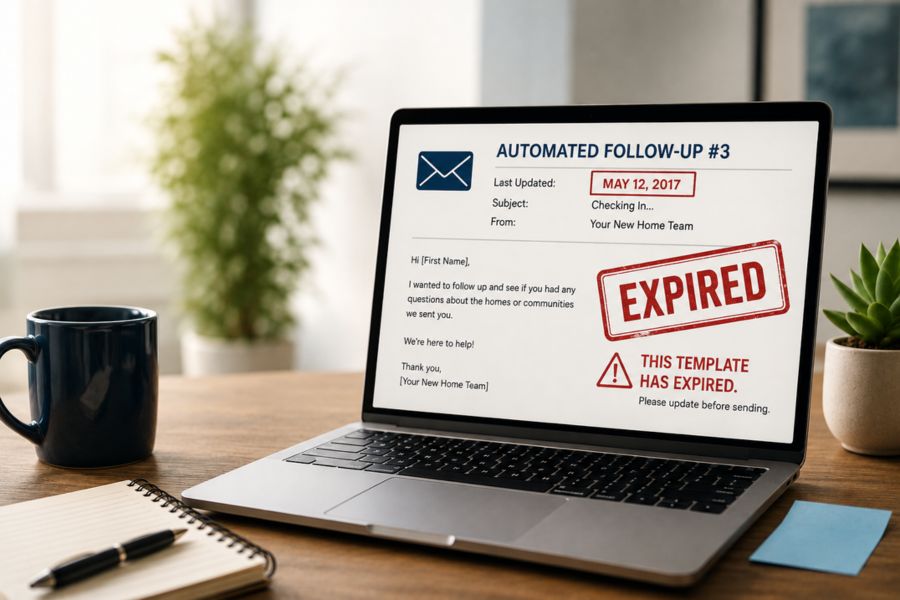 One of the first things I ask for when I start working with a new builder has nothing to do with conversion rates, lead response times, or appointment-setting percentages. Well okay I ask for all of that stuff. But I also ask for this…
I ask to see every follow-up sequence living inside their CRM.
The automated emails. The texts. The videos. The call tasks. Everything.
Why?
Because before I can coach an Online Sales Counselor, I want to understand what the buyer is experiencing. Every email, every text message, and every automated touchpoint shapes that experience long before the OSC ever has a real conversation.
And I ask it to be sent from the OSC… not, “Give me access to your CRM so I can look at all your follow up processes or sequences.” Whether it’s a newly hired OSC, or one who has been working there for several years. I want them to send them to me.
Why do I do this? It’s not because I’m lazy. It’s because I want the OSCs to know exactly what they are sending, where those emails live, what they say, and how to edit and access them. As a consultant, I’m not going to be there forever. But as an OSC, with any luck they will be there for a long, long time. And I want them to know how to find, edit, and improve their follow up.
If I’m just looking into their CRM, or even worse, uploading my own templates, they never really know what’s happening behind the curtain.
Stories From Onboarding New OSCs
I was working with a builder that had recently refreshed their OSC team. While the current OSCs went to different positions within the company, I was tasked with hiring a whole new team. Once we found the right people for the position we began their onboarding. As part of that process they sent me the existing follow-up processes that had already been loaded into the CRM. Who knows how long they’d been sitting there.
It didn’t take long before I realized I wasn’t just reviewing their follow up. I was looking at something that was at least nine or ten years old. It was canned, general, and generic. It could have gone out to anyone, for any reason, from any company, and did not have any personality, sense of time, or sense of customization. Honestly if I stripped off the company logo, it could have come from any builder. And I have the vague recollection from years of Mystery Shops that I’ve seen these templates before.
No one intentionally creates stale follow-up. It happens gradually. A process or sequence that performed well five or six years ago gets copied into a new process. Maybe CRMs change and processes migrate. New team members inherit it instead of questioning it. Before long, those emails become “the way we’ve always done it.”
The problem is that buyers don’t stay the same. Technology changes. Sales team members change and follow up doesn’t reflect the personality or the current phase of building.
As I worked through the follow-up, I started noticing the same pattern over and over again. The emails weren’t necessarily bad. They were simply… disconnected from the buyer.
One email asked whether the buyer had received a video. Fair enough. Except the entire email focused on the video instead of why the buyer should spend thirty seconds watching it. Oh, and by the way, the company had dropped the video email software because they never saw the value in it. Probably because they were sending out canned videos that were 9 years old. If I’m a homebuyer sorting through dozens of emails, I’m not asking myself whether I received your video. I’m wondering whether it’s worth my time.
Another email encouraged the buyer to schedule a phone call. Again, nothing wrong with that. But it never explained what the buyer would gain from that conversation. Would they better understand available homes? Narrow down communities? Compare floor plans? Save themselves hours of research? Those are reasons someone might actually want to talk to you.
As I wrote my coaching notes, I found myself asking the same question over and over:
Why does this email exist? Not what day it gets sent. Not whether it has a nice subject line. (Though most of them didn’t) Not whether it sounds friendly. Why does it exist?
If you can’t answer that question, there’s a good chance your buyer can’t either. And if the answer is, “Well that’s when my process or training says to send another touch point…” Well again that’s not the answer. We need to ask ourselves each time, is this going to advance the conversation? Is this going to engage the buyer where they are?
Make the Shift
One of the biggest opportunities I see in builder follow-up is shifting the focus away from the company and back to the customer. Too many emails explain what the builder wants to do instead of what the buyer needs.
“We wanted to check in.” “I wanted to introduce myself.” “I wanted to see if you had questions.” Those statements aren’t wrong, but they’re all written from the company’s perspective.
Instead, think about what’s happening in the buyer’s world.
Maybe they toured three communities over the weekend and can’t remember which floor plan belonged to which builder. Maybe they’re trying to decide whether they should build from the ground up or purchase a quick move-in home. Maybe they’re overwhelmed by pricing, financing, school districts, or simply trying to figure out where to begin.
Your follow-up should meet them there.
Another thing I encourage builders to watch for is generic language that could have come from absolutely anyone. If I removed your company logo from the email, would a buyer still know it came from your organization? Could the same message have been sent by every other builder in town? If the answer is yes, you’ve lost an opportunity to differentiate yourself.
The strongest follow-up doesn’t just introduce the company. It demonstrates that there’s a knowledgeable human behind the email who understands the buying process and is ready to make it easier. That doesn’t mean every email needs to be completely rewritten every six months. It does mean your sequences deserve the same attention you give your website, your model homes, and your marketing campaigns.
Builders routinely update floor plans. They refresh model homes. They redesign websites. They launch new communities. Yet many are still relying on follow-up that hasn’t had a meaningful review in years.
Auditing Your Own Email Follow-Up
If it’s been a while since you’ve looked at yours, here’s a simple exercise. Open your Day 1 email and read it as if you’re a prospective buyer seeing it for the first time.
Ask yourself a few questions.
- Does this sound like a real person?
- Does it acknowledge why I’m receiving this email?
- Does it provide value, or is it simply another touchpoint?
- Does it give me a compelling reason to respond?
- Would I reply if I received it?
You might be surprised by the answers.
Sometimes the biggest improvements don’t come from buying a new CRM, adding another automation, or creating another template. Sometimes they come from opening the templates you already have and asking whether they still reflect the experience you want your buyers to have.
Because every automated email is doing one of two things.
It’s either helping your OSC start a conversation… Or quietly giving your buyer another reason to ignore the next email you send.